
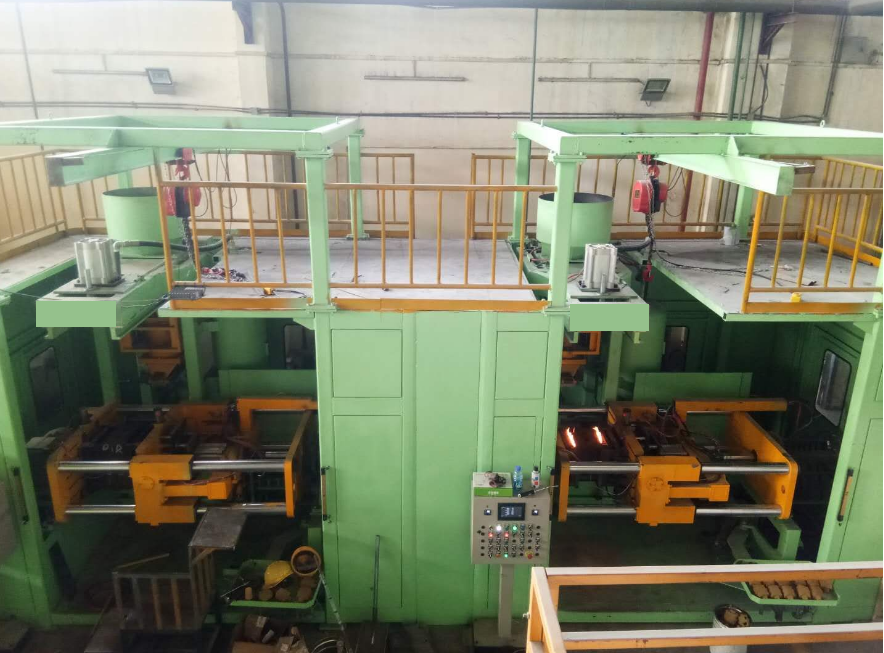
How to Select a Core Shooting Machine
Selecting the right core shooting machine requires more than matching a core weight to a machine model. Core geometry, core box dimensions, core-making process, shooting capacity, required output and automation level all influence the final equipment configuration.
For foundries evaluating a new core shooter, the most effective approach is to start with the core and core box, then determine the process and production requirements before selecting the machine.
This guide explains the main factors that should be considered when selecting a core shooting machine and the technical information an equipment supplier needs for a proper evaluation.
1. Start with the Core
The first step is to understand the core itself.
Important information includes:
Core dimensions
Core weight
Core geometry
Wall thickness and structural features
Number and arrangement of core sections
Required production quantity
A simple, compact core and a large, complex thin-walled core may require very different machine configurations even if their weights are similar.
For this reason, core weight alone should not be used to select a core shooting machine.
A core drawing is normally the best starting point for technical evaluation. If a drawing is not yet available, clear photos together with overall dimensions and approximate weight can also provide useful preliminary information.
2. Check the Core Box Dimensions
The core box is one of the most important factors in machine selection.
The supplier should normally know:
Overall core box dimensions
Core box structure
Parting arrangement
Number of cavities
Required opening or core-pulling movements
Approximate core box weight, where relevant
The machine must provide sufficient space for the core box and the required operating movements.
The shooting area must also be suitable for the actual core box and shooting arrangement.
Therefore, two core boxes producing cores of similar weight do not necessarily require the same machine.
When available, providing both the core drawing and core box drawing allows a more reliable equipment evaluation.
3. Confirm the Core-Making Process
Before selecting a machine series, the required core-making process must be confirmed.
Cold Box Process
In the cold box process, prepared sand is shot into the core box and cured by a gaseous catalyst system.
A cold box machine configuration may involve:
Core shooting
Gas generation and supply
Curing and purging
Exhaust gas collection
Core box handling
Sand preparation and distribution
For individual machine applications, WELTOP NEXA offers Cold Box Core Shooters. For projects requiring a higher degree of integration, the equipment can form part of a Cold Box Core Making System.
Hot Box Process
Hot box core making uses a heated core box to cure the core material.
Machine selection therefore needs to consider not only shooting requirements but also:
Core box dimensions
Heating method
Temperature control
Core-pulling requirements
Production cycle
Single- or double-station configuration
For these applications, Hot Box Core Shooters can be configured according to the required core and production process.
Resin-Coated Sand / Shell Core Process
For resin-coated sand applications, the machine and heated tooling work together to form and cure the required core or shell.
Selection should consider the core or shell geometry, core box size, shooting requirement, heating method and production cycle.
WELTOP NEXA Shell Core Machines are designed for this type of application.
The core-making process should therefore be confirmed before selecting a specific machine model.
4. Evaluate the Required Shooting Capacity
Shooting capacity is an important machine parameter, but it is frequently misunderstood.
A machine with a specified shooting volume does not mean that every core up to an equivalent sand weight can automatically be produced successfully.
Actual requirements depend on factors such as:
Core volume
Core geometry
Sand process
Core box design
Shooting area
Sand flow and filling characteristics
Shooting arrangement
A complex core with narrow passages or difficult-to-fill sections can present different requirements from a simple core of similar weight.
For this reason, the required shooting capacity should be evaluated together with the core drawing and core box, rather than selected from core weight alone.
5. Determine the Required Production Output
A technically suitable machine must also meet the foundry's production requirements.
Useful information includes:
Required cores per hour or per shift
Working hours per day
Number of working days
Number of core types
Frequency of core box changes
Expected future production requirements
For example, a foundry producing several core types in smaller batches may place greater importance on flexibility and tooling changeover.
A high-volume production project may place greater emphasis on cycle organization, multiple stations, automated material handling and integration with upstream and downstream equipment.
Therefore, equipment selection should consider both current production requirements and reasonable future expansion.
6. Consider Single-Station, Multi-Station and Automation Requirements
Not every application requires a highly automated system.
A standalone core shooting machine may be appropriate where operators handle core boxes and finished cores manually or where production volumes are moderate.
For higher production requirements, the project may require additional functions such as:
Multiple working stations
Automated core box handling
Sand conveying and dosing
Sand mixing and distribution
Gas supply and curing
Robotic core handling
Automatic core dipping
Integrated exhaust handling
The appropriate automation level depends on the actual production process.
Adding automation without understanding the production requirement can increase system complexity without providing a corresponding production benefit. Conversely, insufficient automation can create unnecessary manual handling or restrict future capacity.
The correct approach is to define the production process first and then determine which functions should be automated.
7. Machine Selection Should Be Based on the Complete Application
A practical core shooting machine selection process can be summarized as:
Core → Core Box → Core-Making Process → Shooting Requirement → Production Output → Automation Level → Machine Configuration
This is more reliable than beginning with a machine model and trying to determine whether the application can be adapted to it.
For preliminary technical evaluation, foundries should ideally provide the following information:
Required Information | Why It Matters |
|---|---|
Core drawing or clear photo | Evaluates core geometry and structural features |
Core dimensions | Determines the basic application range |
Core weight | Helps evaluate machine and handling requirements |
Core box dimensions | Determines machine space and tooling compatibility |
Core box drawing, if available | Allows more detailed technical evaluation |
Core-making process | Determines cold box, hot box, shell or other configuration |
Required output | Determines production and cycle requirements |
Automation requirements | Determines standalone machine or integrated system scope |
Complete information is not always available during the early project stage. A preliminary evaluation can still begin with the core drawing or photo, approximate core dimensions and weight, core box dimensions and required process.
8. Common Mistakes When Selecting a Core Shooter
Several common mistakes can lead to an unsuitable machine configuration.
Selecting only by core weight.
Core geometry and core box design can be just as important as weight.
Selecting only by shooting volume.
Nominal shooting capacity is not a substitute for evaluating the actual core and tooling.
Ignoring the core box.
The machine must accommodate the tooling dimensions, movements and shooting arrangement.
Choosing the machine before confirming the process.
Cold box, hot box and resin-coated sand applications require different process configurations.
Focusing only on current output.
Where production is expected to increase, reasonable future requirements should be considered during the initial evaluation.
These issues can usually be avoided by carrying out application-based technical evaluation before finalizing the machine model.
Which Core Shooting Machine Is Suitable for Your Application?
There is no single core shooter configuration suitable for every foundry application.
WELTOP NEXA evaluates equipment according to the core geometry, core box dimensions, core weight, core-making process, shooting requirements, required output and automation level.
Depending on the application, the suitable solution may be a:
Cold Box Core Shooter
Hot Box Core Shooter
Shell Core Machine
Multipurpose Core Shooting Machine
Integrated Core Making System
For an initial technical evaluation, send us your core drawing, core box information, core weight, core-making process and required production output.