
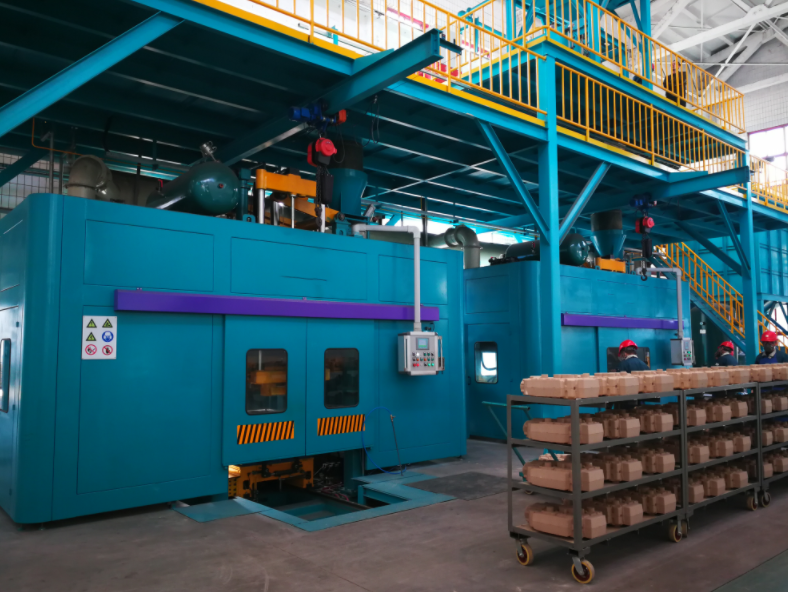
How a Cold Box Core Making System Is Configured
A cold box core making system is more than a core shooting machine.
For stable and repeatable production, the core shooter must work together with sand preparation, binder dosing, sand distribution, gas generation, purging, exhaust treatment, core handling and the control system.
The exact configuration varies from one foundry to another. A system producing small automotive cores at high volume may be very different from one producing larger industrial cores in multiple batches.
For this reason, a cold box core making system should be configured around the core range, core boxes, binder process, required output, automation level and plant layout rather than around a standard equipment list.
This guide explains the main sections of a cold box core making system and the information required to configure one correctly.
1. Start with the Core — Not the Equipment List
Before selecting machines, the first step is to define what the system needs to produce.
Important core information includes:
Core dimensions
Core weight
Core geometry
Number of core types
Core box dimensions
Number of cavities per core box
Core box parting arrangement
Required cores per hour or shift
Changeover frequency
These parameters determine much of the downstream equipment configuration.
For example, core size and weight influence the required shooting capacity and machine working envelope, while the required output influences the number of machines, stations, sand preparation capacity and degree of automation.
A useful engineering sequence is:
Core → Core Box → Process → Required Output → Equipment Configuration → Automation → Plant Layout
Starting from this sequence helps prevent a common mistake: selecting individual machines first and trying to connect them into a production line afterward.
2. Sand Preparation and Binder Dosing
The cold box process begins before sand reaches the core shooter.
For common phenolic urethane cold box processes, sand is mixed with the binder components before being shot into the core box. The prepared mixture must be sufficiently consistent for reliable filling and curing.
Depending on the production scale, the sand preparation section can include:
Sand storage
Sand weighing
Binder storage
Binder metering and dosing
Sand mixer
Additive dosing where required
Sand discharge and transfer
Automatic systems can integrate sand weighing, binder/additive dosing and mixing to improve process consistency. Commercial cold-box installations also use automated batching and sand distribution systems to supply one or several core shooters.
Why accurate dosing matters
The objective is not simply to mix sand and resin.
The system needs to deliver a repeatable prepared sand mixture to the core-making machine.
Therefore, mixer capacity should be determined according to:
Sand consumption per core
Number of cores per cycle
Production cycles per hour
Number of core shooters
Binder system
Required buffer capacity
Production scheduling
A larger mixer is not automatically better. The mixer and downstream distribution system should be matched to actual sand consumption and production rhythm.
3. Sand Distribution to the Core Shooters
Once the sand is prepared, it must reach the machines reliably.
Depending on the plant configuration, mixed sand may be transferred by:
Direct mixer-to-machine feeding
Travelling hopper
Distribution hopper
Conveyor or transfer system
Automated sand distribution system
Industrial core shops can use filling/distribution systems to supply prepared mixtures to multiple shooting machines, while travelling batch hoppers and track systems can reduce manual handling between process stages.
The correct arrangement depends strongly on plant layout.
For a single cold box core shooter, a relatively simple feeding arrangement may be sufficient.
For several machines, the question becomes:
How can prepared sand be supplied to the correct machine, in the required quantity, at the required time, without interrupting production?
This is why sand distribution should be considered during system design rather than added later as an isolated auxiliary function.
4. Cold Box Core Shooting Machine
The cold box core shooter is the central production machine.
Its basic functions typically include:
Core Box Closing → Sand Shooting → Gassing → Purging → Core Box Opening → Core Removal
For common amine-cured cold box processes, prepared sand is blown into the room-temperature core box. The catalyst is then introduced through the tooling to cure the binder, followed by an air purge before the core is removed.
Machine selection should consider:
Maximum core box dimensions
Core box weight
Shooting area
Shooting capacity
Core box parting direction
Opening stroke
Core-pulling requirements
Gassing arrangement
Core removal method
Required cycle time
Modern machines can also incorporate PLC/HMI control, hydraulic/pneumatic or servo drives, automatic tooling movements and interfaces for auxiliary equipment.
One machine or several machines?
This depends on production requirements.
A project may use:
One standalone core shooter
for relatively simple or lower-volume production;
Several independent core shooters
for different core families;
or
Multiple machines integrated into one automated system
for higher production volumes and coordinated material handling.
The correct solution should be determined from the complete production mix rather than simply from annual tonnage.
5. Gas Generation and Delivery
For amine-cured cold box processes, the gassing system is a critical part of the installation.
The catalyst must be introduced into the sand mass in a controlled and repeatable manner.
In a typical PU Cold Box process, a vaporized tertiary amine catalyst is passed through the prepared sand after shooting. The catalyst promotes rapid curing, after which dry air is used to purge residual amine from the core.
The gas system therefore needs to work together with:
Core shooter
Gassing plate
Core box
Gas distribution passages
Venting
Process timing
Purging system
Uniform gas distribution is particularly important for complex cores.
A large core does not necessarily require only “more gas.” Core geometry, section thickness, gas-flow path, tooling design and vent arrangement also affect the curing process.
Therefore, the gas system should be configured together with the core box and core-making process, not selected independently.
6. Purging and Exhaust Gas Treatment
After curing, residual catalyst needs to be removed from the core and tooling area.
In the PU Cold Box process, dry-air purging forces residual amine through and out of the hardened core. The exhaust can then be conveyed through ducting to a scrubber or other appropriate treatment system.
This makes the exhaust system an integral part of an amine-based cold box installation.
A typical arrangement may include:
Core Box / Machine Extraction → Exhaust Ducting → Amine Treatment System → Treated Exhaust
The exact configuration must be designed according to the catalyst system, process requirements and applicable workplace and environmental requirements.
Commercial core-room equipment suppliers likewise integrate amine scrubbers and extraction systems with the working area of cold box core shooters.
Why this should be planned early
Exhaust treatment affects:
Machine enclosure
Duct routing
Plant layout
Utility requirements
Maintenance access
System control
Workplace environment
Leaving exhaust planning until after the core shooters have been installed can create unnecessary layout and integration problems.
7. Core Removal and Handling
After curing and opening the core box, the finished sand core must be removed without damage.
The appropriate handling method depends strongly on:
Core weight
Core geometry
Core strength
Production rate
Required orientation
Downstream process
For simple production, manual core removal may be practical.
As output increases, the system can incorporate:
Automatic core unloading
Core extraction devices
Manipulators
Robots
Transfer conveyors
Core pallets
Automatic positioning
Commercial cold box machines can be configured with automatic core transfer or extraction functions, and core-shop automation can extend into deburring, gluing, handling and transportation.
The important principle is:
Automation should follow the actual core-handling requirement.
Adding a robot does not automatically make a system better. The handling solution should match the core geometry, required takt time and downstream process.
8. Core Finishing and Downstream Operations
Depending on the casting process, core production may not end when the core leaves the machine.
Additional operations can include:
Core inspection
Flash removal / deburring
Core assembly
Gluing
Coating or dipping
Drying
Marking
Palletizing
Transfer to molding or assembly
Automated post-processing solutions are available for functions such as deburring, gluing, handling and transportation.
However, these functions should not automatically be included in every project.
For many foundries, the best solution may be to automate only the processes that create a real production bottleneck or quality issue.
This is why system engineering should distinguish between:
Required Process Equipment
and
Optional Automation Equipment
9. Central Control and System Integration
Once multiple machines and auxiliary systems are connected, control integration becomes increasingly important.
A cold box core making system may need to coordinate:
Sand preparation
Binder dosing
Sand distribution
Core shooters
Gas generation
Exhaust system
Core handling
Safety interlocks
Production monitoring
PLC/HMI-based systems can provide process parameter setting, operating status and fault information, while larger core-shop systems may also incorporate production monitoring and data logging.
The required control level depends on the project.
A standalone machine does not require the same control architecture as a multi-machine automated core shop.
For an integrated system, however, the equipment should be designed as one coordinated production process rather than several independent machines sharing the same floor space.
10. Utilities and Plant Infrastructure
A cold box system also depends on infrastructure outside the equipment itself.
During project planning, the foundry should confirm requirements such as:
Electrical supply
Compressed air
Exhaust connection
Binder and catalyst storage
Sand supply
Floor loading
Installation space
Maintenance access
Material flow
Ventilation and applicable environmental controls
The actual requirements depend on the selected equipment and binder process.
This information is particularly important for international projects because available power standards, factory layout and local environmental requirements can vary significantly from one plant to another.
Providing this information early reduces redesign during the later engineering stage.
11. How the Required Output Affects System Configuration
Required output is one of the most important inputs for system engineering.
Consider two foundries producing the same core.
One needs 100 cores per shift.
The other needs 1,000 cores per shift.
The core itself may be identical, but the appropriate system configuration can be completely different.
The second project may require:
Additional shooting stations
Larger or more frequent sand preparation
Automated sand distribution
Automatic core unloading
Robotic handling
Automated downstream operations
Production buffers
Centralized control
Therefore, capacity evaluation should consider the complete production cycle:
Required Output ÷ Available Production Time → Required Effective Production Rate
Then evaluate:
Shooting + Gassing + Purging + Opening + Core Removal + Tooling Movement + Handling
The nominal cycle time of the core shooter alone does not define the output of the complete system.
12. Plant Layout Is Part of System Engineering
An integrated cold box system must fit the actual factory.
A technically suitable collection of machines can still result in an inefficient production line if material flow and maintenance access are poorly arranged.
Layout engineering should consider:
Raw sand entry
Binder storage
Sand preparation
Sand distribution
Core shooter locations
Core box change area
Exhaust ducting
Core removal
Core finishing
Finished core flow
Maintenance access
Operator access
Safety zones
The objective is to create a logical production flow while minimizing unnecessary transport and handling.
For brownfield projects, existing columns, pits, utilities and surrounding production equipment may strongly influence the final configuration.
For this reason, a plant layout drawing is extremely useful when evaluating an integrated core-making project.
13. Standalone Equipment or Integrated System?
Not every foundry needs a complete automated core-making line.
A practical distinction is:
Production Requirement | Typical Approach |
|---|---|
Limited production / few core types | Standalone cold box core shooter |
Several core families | Multiple core shooters with shared auxiliary equipment |
Higher-volume production | Coordinated sand preparation and machine feeding |
High-volume automated production | Integrated core making system with automatic handling |
Existing core shop upgrade | Selected automation or process modules integrated with existing equipment |
The objective should not be to maximize automation.
It should be to determine which functions need to be integrated to achieve the required quality, output and operating efficiency.
This is particularly important when upgrading an existing core shop. Existing mixers, core boxes, exhaust systems or handling equipment may sometimes remain part of the new process if technically compatible.
14. What Information Is Needed to Configure a Cold Box Core Making System?
For preliminary system engineering, the following information is particularly useful:
Information | Why It Matters |
|---|---|
Core drawings / photos | Defines geometry and production difficulty |
Core dimensions and weight range | Determines machine and handling range |
Core box dimensions | Determines machine compatibility |
Number of core types | Determines production flexibility |
Binder / Cold Box process | Determines mixing, gassing and exhaust requirements |
Required output | Determines equipment quantity and automation |
Working hours / shifts | Required for capacity calculation |
Existing equipment | Identifies equipment that may be retained |
Automation requirement | Defines handling and integration scope |
Available plant layout | Determines equipment arrangement |
Electrical supply / utilities | Required for engineering |
Downstream operations | Determines handling and finishing scope |
If all information is not yet available, a project can still begin with:
Core Range + Core Box Information + Required Output + Existing Process + Plant Layout
These five items are usually enough for an initial system discussion.
15. A Practical Cold Box System Configuration
A complete project can therefore be understood as a sequence of functional modules:
Sand Storage & Dosing
↓
Binder Metering & Sand Mixing
↓
Sand Distribution
↓
Cold Box Core Shooting
↓
Gassing & Purging
↓
Exhaust Collection & Treatment
↓
Core Removal & Handling
↓
Finishing / Coating / Transfer
Not every project requires every module.
The correct configuration depends on the actual production process.
This is the key difference between buying a cold box core shooter and engineering a cold box core making system.
Configuring a Cold Box Core Making System for Your Foundry
At WELTOP NEXA, an integrated cold box project should begin with the production requirement rather than a predetermined equipment package.
The system configuration is evaluated according to:
Core Range → Core Boxes → Cold Box Process → Production Capacity → Automation → Plant Layout
Depending on the project, the system can integrate:
Sand conveying and dosing
Binder dosing
Sand mixing and distribution
Cold box core shooting machines
Gas generation and delivery
Exhaust collection
Core handling
Robotic transfer
Core finishing or dipping
Centralized control
Individual equipment and automation functions can then be configured according to the actual project scope.
Planning a Cold Box Core Making System?
Send us your core range, core box information, required output, existing core-making process, automation requirements and available plant layout.
We can evaluate the appropriate equipment scope and system configuration for your project.